
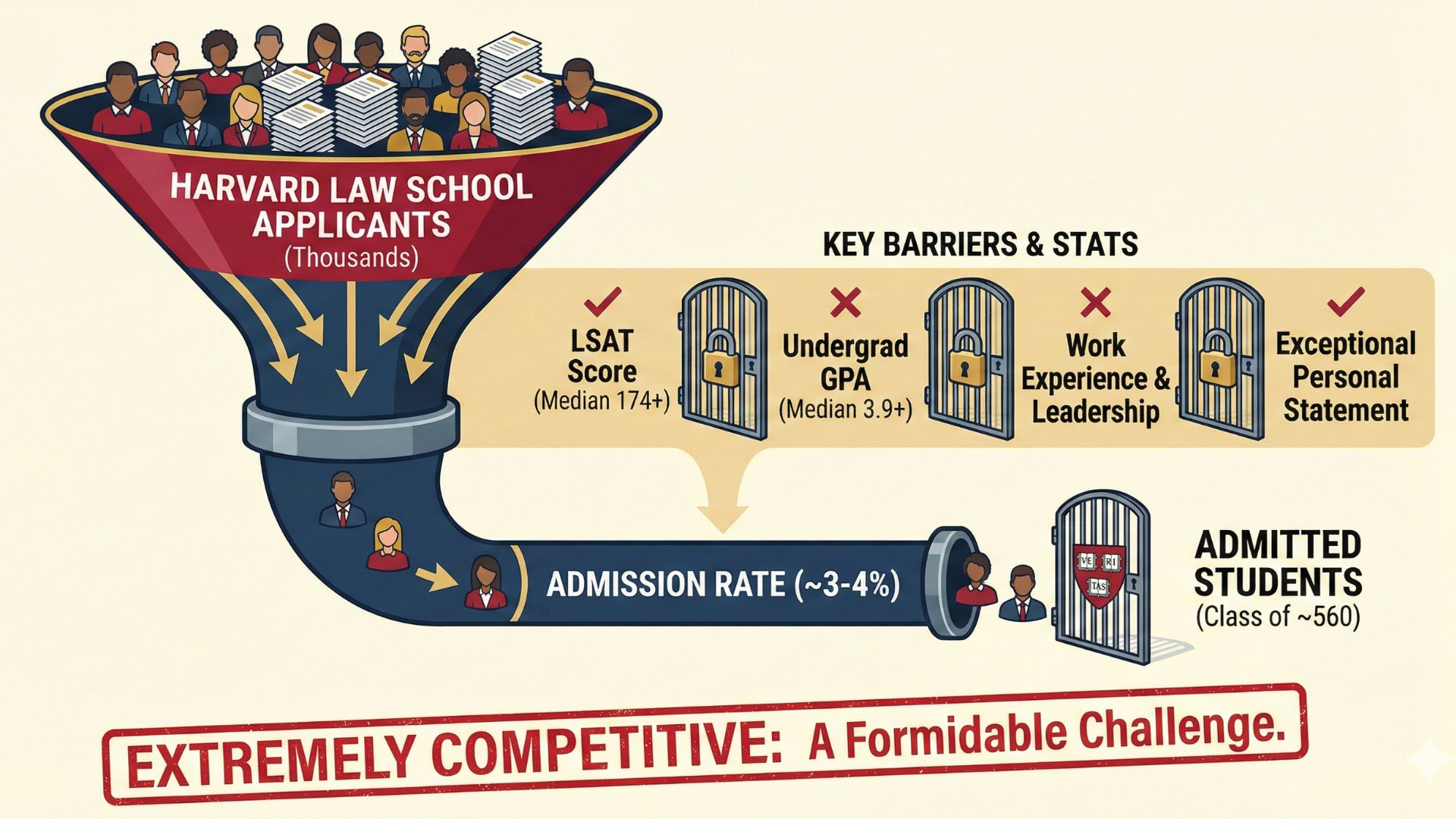
How Hard is it to Get into Harvard Law: Harvard Law School is one of the most prestigious academic institutions in the world. Often regarded as a global leader in legal education, Harvard Law School (HLS) has produced some of the most influential judges, lawyers, scholars, and political leaders in history. Because of its reputation, many students aspiring to become top-tier legal professionals have one question: How hard is it to get into Harvard Law School?
The short answer is that gaining admission to Harvard Law is extremely challenging. It requires exceptional academic performance, strong test scores, compelling experiences, and a unique intellectual and personal profile. However, the longer answer is more nuanced, as the admissions process is holistic and considers much more than grades and standardized test scores.
Understanding Harvard Law School’s Reputation and Selectivity
Harvard Law School is one of the oldest and most reputable law schools in the United States. Its prestige creates a large and highly competitive applicant pool every year. Thousands of highly qualified applicants apply annually, while only a fraction are admitted.
Three factors make Harvard Law especially competitive:
1. Global Recognition
HLS is renowned worldwide, attracting applicants from dozens of countries.
2. Exceptional Career Outcomes
Graduates regularly secure positions at top law firms, clerkships, government roles, and academic institutions.
3. Highly Competitive Applicant Pool
Most applicants have exemplary academic records, strong test scores, and impressive professional backgrounds.
Because of these factors, Harvard Law maintains an elite, highly selective admissions process that admits only the strongest candidates.
Is It Hard to Get Into Harvard Law School?
Yes, it is very hard. Harvard Law is among the most selective law schools in the world, and each year, the acceptance rate reflects the intense competition.
Key Reasons Why It Is Hard:
- Large number of applicants
- Small class size compared to demand
- High test score ranges
- Highly qualified applicants with similar credentials
- Emphasis on holistic excellence, not just academic performance
- Strong competition from both domestic and international applicants
Getting into Harvard Law requires much more than fulfilling minimum requirements. You must excel across academics, personal qualities, leadership, and professional experiences.
Harvard Law School Acceptance Rate
While the exact acceptance rate varies slightly each year, it typically ranges between 10 to 15 percent, sometimes dipping even lower depending on applicant volume.
To understand this percentage:
- Thousands apply
- Only a few hundred receive admission offers
- Many more applicants meet the basic qualifications than available spots
Even if you have excellent grades and test scores, admission is not guaranteed.
Academic Expectations: GPA Requirements for Harvard Law
Harvard does not publish a minimum required GPA, but successful applicants typically have very high undergraduate academic performance.
Typical GPA Range for Admitted Students:
- Many successful applicants have GPAs of 3.8 and above (on a 4.0 scale)
- High-achieving students with GPAs between 3.7 and 3.9 also gain admission
- Applicants with lower GPAs occasionally get in if they have extraordinary qualities, professional experience, or exceptional LSAT scores
What Harvard Looks For in Academic Performance?
- Rigor of coursework
- Course selection in relation to major
- Consistent academic excellence
- Signs of intellectual curiosity and engagement
Grades are important but not the only factor. Harvard seeks applicants who show depth of thought and a strong academic foundation.
LSAT Expectations: How High Should Your Score Be?
The LSAT is a critical component in the application process. Harvard typically accepts applicants with very high LSAT scores.
Typical LSAT Score Range for Harvard
- Many admitted students score between 170 and 175+
A high LSAT score strengthens your application significantly, showing strong analytical and logical reasoning skills.
Do You Need a Perfect Score?
No, but a score above 170 is strongly recommended. However, students with slightly lower scores may still be admitted if they have exceptional qualities elsewhere in their application.
GRE Option for Harvard Law Applicants
Harvard Law also accepts the GRE. Some applicants choose to submit GRE scores instead of the LSAT.
Why Some Choose GRE?
- Strength in other subject areas
- Better performance on GRE-style questions
- Greater flexibility for dual-degree applicants
However, competitive GRE scores must still reflect high intellectual ability.
Work Experience and Professional Background
Work experience is not required, but it significantly strengthens an application. This is especially relevant for applicants who:
- Join the workforce after completing undergraduate studies
- Engage in public service, research, or non-profit roles
- Work in law-related fields
- Participate in government, corporate, or NGO projects
Harvard values applicants who demonstrate maturity, leadership, and practical insight into legal issues.
Personal Statement: A Critical Component
Your personal statement plays a major role in determining admission outcomes. It allows Harvard to understand your motivations, goals, and personal experiences.
Strong Personal Statements Typically Include:
- Clear articulation of why you want to study law
- Experiences that shaped your worldview
- Professional or academic achievements
- Insightful reflection and self-awareness
- Evidence of commitment to justice, leadership, or service
A strong, compelling personal narrative can distinguish you from applicants with similar or even stronger academic credentials.
Letters of Recommendation
Harvard requires letters of recommendation, typically from professors or supervisors.
Strong recommendations demonstrate
- Intellectual capability
- Work ethic
- Critical thinking skills
- Academic or professional excellence
- Leadership potential
- Personal integrity
The quality of recommendations carries significant weight.
Extracurricular Activities and Leadership
Harvard evaluates applicants holistically. Leadership roles, extracurricular involvement, and community contributions strengthen applications.
Examples include:
- Student organizations
- Debate teams
- Volunteer work
- Research projects
- Internships
- Publications
- Public speaking engagements
HLS seeks students who will contribute meaningfully to the campus community.
Diversity, Background, and Unique Perspectives
Harvard values diversity across:
- Cultural backgrounds
- Life experiences
- Career paths
- Academic interests
- Socioeconomic status
Applicants who bring unique perspectives often stand out.
Myths About Getting Into Harvard Law School
Myth 1: Only perfect students get in
Reality: Harvard admits individuals with diverse backgrounds, not only perfect academic records.
Myth 2: You must major in political science or pre-law
Reality: Harvard accepts students from all majors, including science, engineering, humanities, and business.
Myth 3: You cannot get in without legal work experience
Reality: Many successful applicants apply directly from undergraduate programs.
Myth 4: Only LSAT scores matter
Reality: Test scores help, but Harvard evaluates character, leadership, and purpose extensively.
How to Increase Your Chances of Getting Into Harvard Law?
1. Excel academically
Strong GPA and rigorous courses are essential.
2. Achieve a high LSAT score
Aim for a score of 170 or higher.
3. Build a strong personal narrative
Use your personal statement to tell your story with clarity and purpose.
4. Pursue meaningful experiences
Quality matters more than quantity.
5. Develop strong relationships with mentors
These individuals will write powerful recommendation letters.
6. Demonstrate leadership
Show initiative in academic or community settings.
7. Highlight your unique strengths
Harvard values originality and diverse viewpoints.
8. Submit a polished and complete application
Presentation and professionalism matter.
Important Links and Information
| Topic | Description | Link |
|---|---|---|
| Harvard Law School | Official website and general information | https://hls.harvard.edu |
| Admissions Overview | Complete admissions process and requirements | https://hls.harvard.edu/admissions |
| J.D. Program | Details about Harvard’s Juris Doctor program | https://hls.harvard.edu/degree-programs/jd-program |
| Financial Aid | Need-based aid and scholarship policies | https://hls.harvard.edu/jd-fa |
| Harvard Graduate School | General Harvard graduate programs | https://www.harvard.edu/schools |
These links guide prospective applicants to official, detailed information directly from Harvard.
FAQ about How Hard is it to Get into Harvard Law
How hard is it to get into Harvard Law School?
It is extremely difficult, with a highly competitive applicant pool and a rigorous holistic selection process.
What GPA do I need for Harvard Law?
While Harvard does not set a minimum GPA, most admitted students have GPAs around 3.8 or higher.
What LSAT score is needed for Harvard Law?
A score of 170 or above is typical for competitive applicants.
Does Harvard Law accept GRE scores?
Yes, Harvard accepts both the LSAT and GRE.
Do I need work experience to apply?
Work experience is not required but often strengthens your application.
Does Harvard Law offer scholarships?
Harvard provides need-based financial aid but no merit-based scholarships.
How important is the personal statement?
Very important. It provides insight into your motivations, character, and goals.
Can international students apply to Harvard Law?
Yes. Many international applicants are admitted each year.
Is it possible to get in with a low GPA or LSAT score?
It is rare, but exceptional applicants with unique experiences or achievements may still be considered.
Conclusion
Gaining admission to Harvard Law School is undeniably difficult. It demands exceptional academic performance, strong standardized test scores, persuasive personal statements, meaningful experiences, and compelling letters of recommendation. However, it is equally important to understand that Harvard Law evaluates applicants holistically. The admissions committee looks beyond numbers to find individuals who demonstrate leadership, originality, integrity, service, and a deep commitment to the legal field.
Harvard Law is looking for future leaders: people who will shape the legal landscape, influence public policy, and contribute positively to society. If you combine academic excellence with purpose, dedication, and authenticity, your chances of being admitted improve significantly.
Even though the process is challenging, it is achievable for those who apply themselves with focus, preparation, and a strong personal mission. If Harvard Law is your goal, understanding the expectations and preparing strategically will bring you closer to earning a place at one of the world’s most respected law schools.