

Can Harvard Revoke Degrees? Harvard University is one of the most prestigious educational institutions in the world, with its name associated with academic excellence, leadership, and integrity. A degree from Harvard carries immense value and can shape the trajectory of a graduate’s career for decades. Given the weight of this credential, many people wonder whether a degree from Harvard is permanent or if there are circumstances under which the institution can take it back.
The idea of a revoked degree may sound surprising, but degree revocation has long been part of university governance. Like many leading institutions, Harvard maintains policies for rescinding degrees under specific and often severe conditions. Understanding how this process works is essential for anyone interested in the academic reputation of universities, the enforcement of academic standards, and the nature of ethical conduct in higher education.
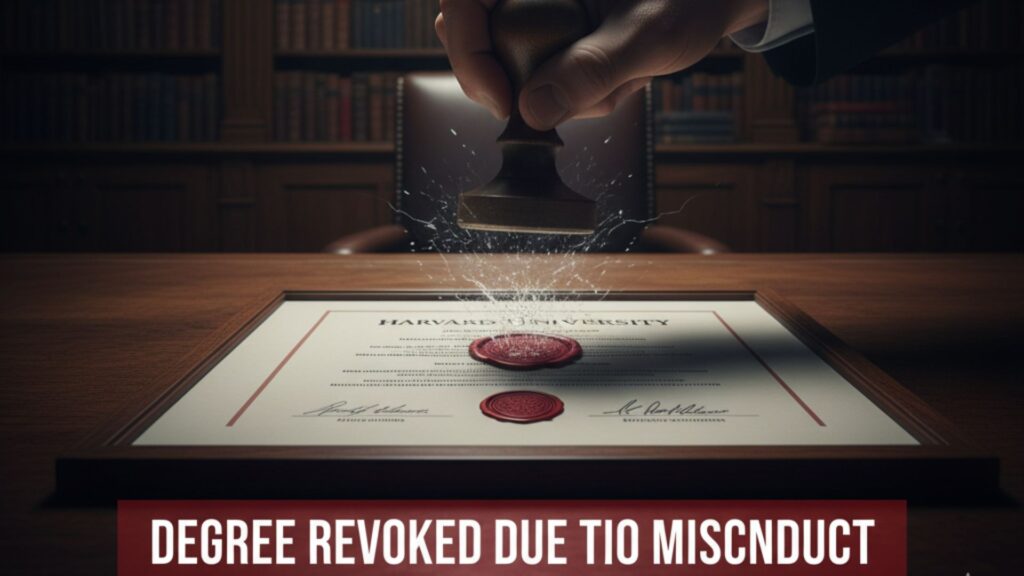
This article explores in detail whether Harvard can revoke degrees, the historical context, the legal and procedural elements involved, real scenarios that lead to degree revocation, and what the implications are for students, alumni, and the academic community.
Important Information and Reference Links
| Topic | Description | Link |
|---|---|---|
| Harvard University Main Website | Official website for general university information | https://www.harvard.edu/ |
| Office of the President | Information on governance, policies, and institutional authority | https://www.harvard.edu/president/ |
| Harvard Faculty of Arts and Sciences | Academic policies, student conduct, and regulations | https://fas.harvard.edu/ |
| Harvard Integrity and Conduct Policies | Framework for academic honesty and discipline | https://honor.fas.harvard.edu/ |
Understanding Degree Revocation: What It Means
Degree revocation refers to the formal removal of an academic credential previously awarded to a student. This action nullifies the degree and removes it from official university records. Institutions take this step only under serious circumstances because a degree is not simply a document. It represents years of academic work, institutional approval, and intellectual accomplishment.
Harvard, like other elite universities, reserves the right to revoke degrees when graduates are found to have violated serious academic, ethical, or legal standards. Revocation is an oversight mechanism designed to preserve institutional credibility. If a graduate is later discovered to have earned the degree fraudulently or through unethical means, the university may take corrective action—even years or decades after graduation.
Can Harvard Revoke Degrees? The Short Answer
Yes. Harvard University can revoke degrees under specific circumstances. This authority is part of its institutional governance and has been exercised in various cases throughout its history. The power to rescind degrees exists to maintain the integrity of the university’s academic standards.
Degree revocation is rare, but it does occur when:
- A serious academic violation is discovered after graduation.
- A student is found to have engaged in research misconduct.
- A graduate’s eligibility requirements were not met due to fraud, misrepresentation, or falsification.
- Serious ethical violations connected to the academic process come to light.
Why Harvard Revokes Degrees: Key Reasons Explained
Harvard does not revoke degrees arbitrarily. Each case goes through multiple levels of evaluation and must meet clearly defined standards. Below are the most common reasons Harvard may consider rescinding a degree.
1. Academic Misconduct Discovered After Graduation
Academic misconduct includes cheating, plagiarism, falsifying data, or violating examination policies. While universities typically address such issues before graduation, it is possible that misconduct remains hidden until later.
If credible evidence surfaces after a graduate has left Harvard, the institution can investigate and, if proven, revoke the degree.
Examples include:
- Plagiarized senior theses
- Fabricated academic work used to meet graduation requirements
- Misrepresented academic submissions
2. Research Misconduct
Harvard places significant emphasis on research integrity. Misconduct such as data fabrication, data manipulation, plagiarism, and unethical laboratory practices can lead to investigations, which may result in degree revocation.
Even if a student has long graduated, if the research used for a thesis or dissertation is later proven fraudulent, the university can rescind the degree.
3. Admission Fraud or Misrepresentation
If a student gained admission to Harvard through false information, forged documents, falsified test scores, or misrepresentation of credentials, the university can revoke the degree because the foundation of their enrollment was invalid.
This applies to both undergraduate and graduate admissions.
4. Ethical Violations Connected to the Degree
Sometimes, unethical behavior that directly relates to academic work can call a degree into question. This could include:
- Coercive behavior in research environments
- Violations of human-subject or laboratory protocols
- Misconduct that undermines the credibility of academic contributions
While personal misconduct outside of academics typically does not lead to degree revocation, ethical violations intertwined with academic work may.
5. Criminal Conduct Connected to Academic Fraud
If a graduate is implicated in crimes that relate to their academic achievements or research, Harvard may investigate. For example, fraudulently obtaining grants or misusing research funds can lead to a review of the degree.
How Harvard’s Degree Revocation Process Works?
Harvard follows a structured, multi-step process before rescinding a degree. This process ensures fairness, due process, and evidence-based decision-making.
1. Initial Review of Allegations
A concern or allegation is submitted to the relevant department, administrative unit, or disciplinary board. The university reviews whether the claim has enough basis to proceed.
2. Formal Investigation
If warranted, Harvard initiates a full investigation that may involve:
- Interviews
- Review of academic records
- Examination of research data
- Consultation with faculty experts
- Analysis of submitted academic work
Graduates are typically notified and allowed to respond.
3. Committee Evaluation
Committees composed of faculty members assess the findings. These committees decide whether the allegations constitute a serious violation.
4. Recommendation to University Leadership
If the committee believes revocation is appropriate, it submits a recommendation to university leadership, such as:
- The Dean
- The President
- The Harvard Corporation
These governing bodies have final authority.
5. Final Decision
Only university leadership—not individual professors or departments—can revoke degrees. The decision is formally recorded and communicated to the affected graduate.
How Common Is Degree Revocation at Harvard?
Degree revocation is rare. Harvard, like most elite institutions, uses this power sparingly. Only cases involving severe violations typically reach this point. The university aims to protect academic integrity while also respecting alumni who earned their credentials legitimately.
The small number of revocations underscores how seriously Harvard treats this action. It is not used for minor infractions or non-academic issues.
Does Harvard Notify the Public When Degrees Are Revoked?
Universities vary in transparency, but Harvard typically does not publicly disclose individual cases unless they become matters of public interest. Privacy laws restrict the release of information about student disciplinary actions. Therefore, unless a case is widely reported in public records or media, most revocations remain confidential.
Can a Revoked Degree Be Appealed?
Yes. Harvard allows alumni to appeal degree revocations. The appeal process usually includes:
- A formal written appeal
- A review of the investigation for procedural fairness
- Consideration of new evidence
- Evaluation by committees or oversight boards
Appeals are difficult but not impossible to win. If procedural errors or misinterpretation of evidence occurred, the decision may be reconsidered.
What Happens to Alumni After a Degree Is Revoked?
Losing a degree can have serious consequences:
- Credentials are removed from Harvard’s official records.
- The graduate cannot represent themselves as a Harvard degree-holder.
- Employers, licensing boards, or academic institutions may rescind positions or certifications.
- Professional reputation may be impacted.
However, the outcome depends on the individual’s career path and the nature of the revocation.
Does Harvard Revoke Degrees for Personal Misconduct?
Generally, no. Harvard typically does not revoke degrees for conduct unrelated to academic achievement or research. Personal controversies, criminal charges unrelated to academics, or political statements do not usually lead to revocation.
The primary focus is academic integrity.
Implications of Degree Revocation for Harvard’s Reputation
By revoking degrees when necessary, Harvard reinforces its commitment to academic honesty. Maintaining rigorous standards strengthens the credibility of every degree the university awards. Though revocation can bring temporary controversy, it ultimately protects the Harvard community and the value of its academic credentials.
FAQ about Can Harvard Revoke Degrees?
Can Harvard revoke degrees many years after graduation?
Yes. Harvard can revoke degrees long after a student has graduated if credible evidence of serious misconduct emerges.
Does Harvard revoke degrees for cheating?
If cheating directly contributed to earning the degree and is proven after graduation, Harvard may revoke the degree.
Can a degree be revoked for non-academic misconduct?
Typically no. Harvard usually reserves revocation for academic or research-related violations.
Is degree revocation public?
Harvard does not always publicly disclose revocations due to privacy policies.
Can someone appeal a revoked degree?
Yes. Graduates can submit appeals if they believe the decision was unfair or new evidence exists.
How often does Harvard revoke degrees?
It is rare. Revocation is considered a last resort.
Who has the authority to revoke a Harvard degree?
Only Harvard’s central governing bodies, such as the Harvard Corporation and university leadership, have this authority.
Are revoked degrees erased from Harvard’s records?
Yes. Once revoked, the degree is removed from official records.
Can Harvard revoke honorary degrees?
Yes. Universities may revoke honorary degrees for ethical or academic reasons.
Does revocation affect all transcripts and documentation?
Yes. Official documentation is updated to reflect the change.
Conclusion
The question “Can Harvard revoke degrees?” highlights a deeper issue about the responsibilities that come with academic achievement. Harvard does have the authority to revoke degrees, but uses this power rarely and carefully. The process is rooted in fairness, rigorous investigation, and a commitment to institutional integrity. Degree revocation serves as a reminder that a Harvard diploma is not just a certificate; it represents a relationship of trust between the student and the university.
The policy protects the value of the Harvard degree and ensures that the institution remains a symbol of excellence built on truth, honor, and intellectual honesty. While the possibility of revocation may seem unsettling, its very existence helps guarantee that Harvard degrees continue to carry unmatched respect around the world.