
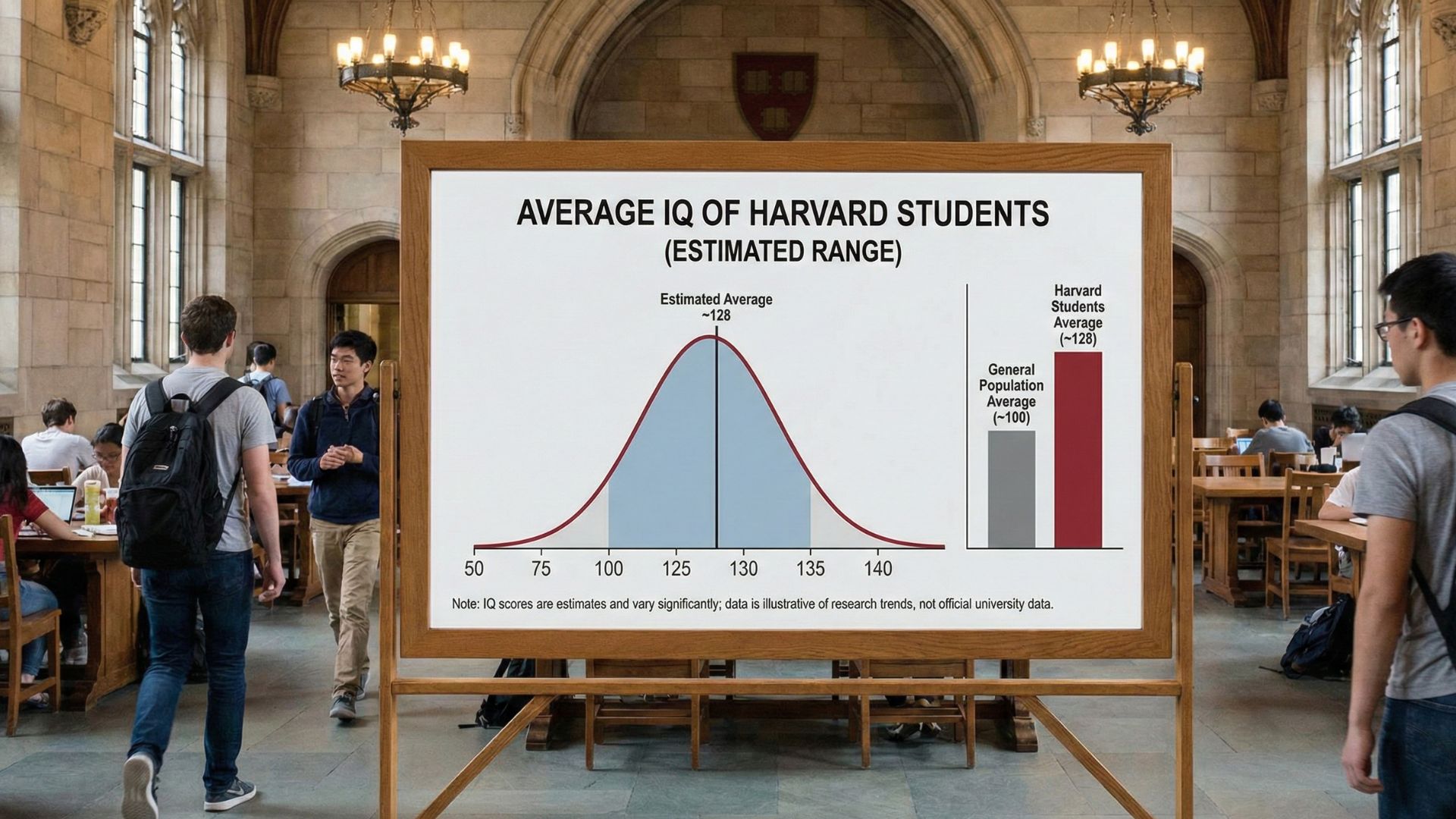
Average IQ of Students at Harvard: Harvard University is widely considered one of the most prestigious educational institutions in the world. With a legacy that spans centuries, a world-renowned faculty, and an exceptionally competitive admission process, Harvard consistently attracts some of the most talented and high-achieving students across the globe. As a result, one of the most frequently asked questions by researchers, students, and the general public is: What is the average IQ of students at Harvard?
While IQ is often used as a measure of cognitive ability and academic potential, it is a complex, controversial, and often misunderstood metric. The relationship between intelligence, measured through standardized tests, and actual performance at elite institutions like Harvard is not as straightforward as many assume. This article explores this topic in depth, discusses the factors that influence Harvard admissions, and explains why IQ alone does not determine success at the university.
Understanding IQ and Its Role in Academic Achievement
IQ, or Intelligence Quotient, is a numerical score derived from standardized psychological tests designed to measure aspects of human intelligence. Traditionally, IQ tests evaluate abilities such as:
- Logical reasoning
- Pattern recognition
- Mathematical problem-solving
- Verbal comprehension
- Spatial reasoning
The average IQ in the general population is set at 100, with a standard deviation of about 15 points. A score of:
- 130+ is generally considered gifted
- 145+ is often categorized as highly gifted
- 160+ is exceedingly rare
In popular culture, top universities like Harvard, Yale, MIT, and Stanford are often associated with extremely high IQs. However, intelligence is multidimensional, and admissions committees at elite universities recognize that potential cannot be measured solely through a single metric.
Does Harvard Measure or Publish IQ Scores?
Harvard University does not administer IQ tests, nor does it publish any official data regarding the average IQ of its student body. Admissions decisions are based on a holistic evaluation of each applicant, which includes factors such as:
- Academic performance
- Standardized test scores (SAT, ACT, AP, IB, etc.)
- Extracurricular achievements
- Leadership qualities
- Community involvement
- Personal essays
- Letters of recommendation
- Interviews
Therefore, IQ is not a direct consideration in the admissions process. However, we can infer approximate intelligence levels indirectly by analyzing admissions competitiveness and standardized test score data.
Estimating the Average IQ of Harvard Students
Since Harvard does not release IQ statistics, researchers often estimate cognitive ability using standardized tests such as the SAT or ACT. These tests, although imperfect, correlate with certain aspects of IQ, particularly reasoning and problem-solving abilities.
Relationship Between SAT Scores and IQ
Research suggests an approximate correlation between IQ scores and SAT results. While not exact, some psychologists use simplified conversion estimates.
For instance:
- SAT score of 1200 ≈ IQ of 115–120
- SAT score of 1400 ≈ IQ of 125–130
- SAT score of 1500+ ≈ IQ of 135–145
Harvard’s admitted students typically score in the top 1 percent of all SAT or ACT test-takers, which allows us to reasonably infer that the average IQ of Harvard students falls significantly above the population mean.
Estimated Average IQ Range at Harvard
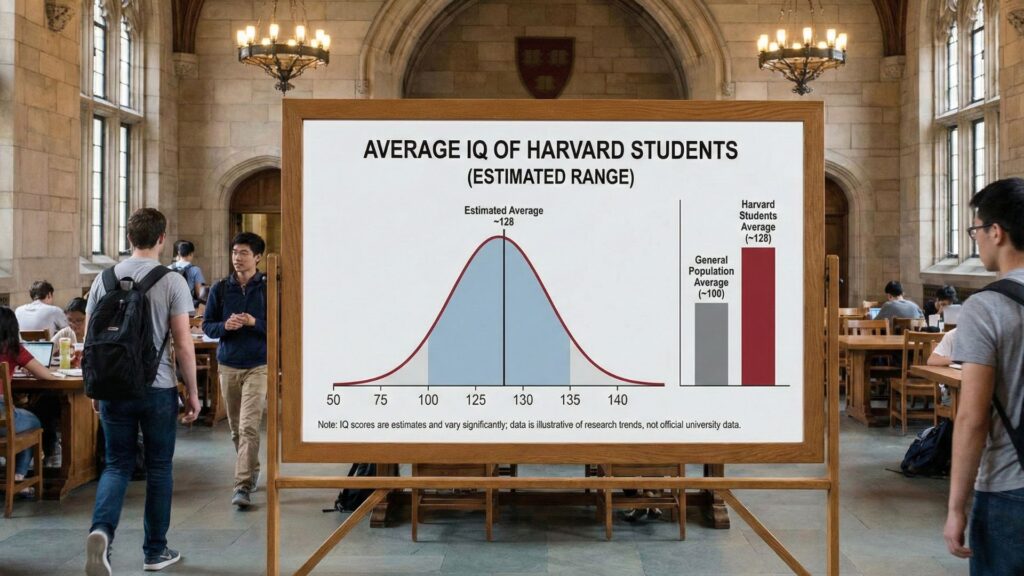
Considering existing research and statistical conversions, many independent analysts estimate that the average IQ of Harvard students falls in the range of 130 to 140.
This range reflects:
- The academic rigor of the curriculum
- The extraordinary competitiveness of the applicant pool
- The high level of cognitive ability required to perform well in standardized tests
- The intellectual demands of Harvard coursework
However, it is important to emphasize that this number is an estimate, not an official figure. IQ varies significantly among individuals, and cognitive ability is only one among many factors that contribute to success at Harvard.
Why IQ Is Not the Primary Factor at Harvard?
Despite popular belief, Harvard does not select students solely based on intelligence. The university looks for individuals who demonstrate:
- Creativity
- Leadership potential
- Commitment to community
- Emotional intelligence
- Ambition and resilience
- Diverse perspectives
- Special talents or achievements
These traits often contribute more to success in education and life than raw cognitive ability.
Factors That Matter More Than IQ at Harvard
Academic Excellence
Harvard students typically maintain exceptional grades in high school or pre-university programs. Academic consistency and depth of study matter significantly.
Passion and Purpose
Admissions committees seek students who demonstrate genuine passion, whether in science, arts, sports, technology, or humanities.
Extracurricular Achievements
National and international recognition in sports, music, research, entrepreneurship, or innovation strengthens applications more than high IQ alone.
Leadership and Initiative
Harvard values students who take initiative, lead projects, and positively impact their communities.
Personal Essays
Essays help identify students with strong critical thinking, emotional maturity, and unique perspectives.
Letters of Recommendation
Teachers and mentors provide insight into the applicant’s character, motivation, and potential.
Myths About Harvard Students and IQ
Myth 1: All Harvard Students Have Genius-Level IQs
Reality: Many Harvard students are exceptionally bright, but not all fall into the “genius” category. Hard work, discipline, and consistency play significant roles.
Myth 2: High IQ Guarantees Admission
Reality: Thousands of applicants with very high IQ-equivalent test scores are rejected every year. Harvard considers the whole person.
Myth 3: Harvard’s Prestige Comes Only From Intelligence
Reality: Harvard’s legacy, network, faculty excellence, research output, and societal influence contribute to its global reputation.
IQ, Intelligence, and Real-World Success
It is essential to understand that IQ has limitations:
- It does not measure creativity
- It does not evaluate emotional intelligence
- It does not reflect motivation or discipline
- It does not guarantee success
Many Harvard alumni succeed in diverse fields not because of high IQ alone but because of holistic traits such as perseverance, communication skills, and adaptability.
Important Links and Information
Below is a table you can include in your blog for quick reference.
| Topic | Description | Link |
|---|---|---|
| Harvard University Official Website | General information about programs, admissions, and academics | https://www.harvard.edu |
| Harvard College Admissions | Undergraduate admission details and requirements | https://college.harvard.edu |
| Harvard Graduate School Programs | Information about graduate schools under Harvard University | https://www.harvard.edu/schools |
| Financial Aid | Details on scholarships, grants, and aid policies | https://college.harvard.edu/financial-aid |
| Harvard Research Programs | Overview of major research initiatives | https://www.harvard.edu/research |
Note: These are public, general informational links included for educational purposes.
FAQ about Average IQ of Students at Harvard
Does Harvard publish the average IQ of its students?
No, Harvard does not measure or publish IQ statistics for its student body.
Is IQ used during Harvard admissions?
No, admissions decisions are made holistically. IQ tests are not part of the process.
Can SAT or ACT scores indicate a student’s IQ?
These tests correlate with certain cognitive abilities, but they do not directly measure IQ. They can provide a rough estimate at best.
What is the estimated IQ range of Harvard students?
Most estimates place the average around 130–140, based on academic performance and test score data.
Can someone with an average IQ get into Harvard?
Yes, if they demonstrate exceptional achievements, talent, leadership, and personal qualities. IQ alone does not determine admission.
Is IQ the best predictor of success at Harvard?
No, dedication, work ethic, creativity, and emotional intelligence are more influential factors.
Do all elite universities have similar IQ averages?
Generally, prestigious institutions attract high-achieving students, but actual averages vary and are never officially published.
Conclusion
The question of the average IQ of students at Harvard is both intriguing and complex. While Harvard does not measure or track IQ, the academic abilities of its students suggest an estimated IQ range of 130 to 140. However, this number alone does not capture the essence of what it means to be a Harvard student.
Harvard seeks individuals with a combination of talent, creativity, leadership, resilience, and purpose. Intelligence contributes to academic success, but it is only one part of a much larger picture. Students at Harvard succeed because they are motivated, disciplined, resourceful, and committed to making a meaningful impact in the world.
Whether you are considering applying to Harvard or simply curious about its academic culture, understanding the broader context behind intelligence and success can help you appreciate the university’s holistic approach to education.