
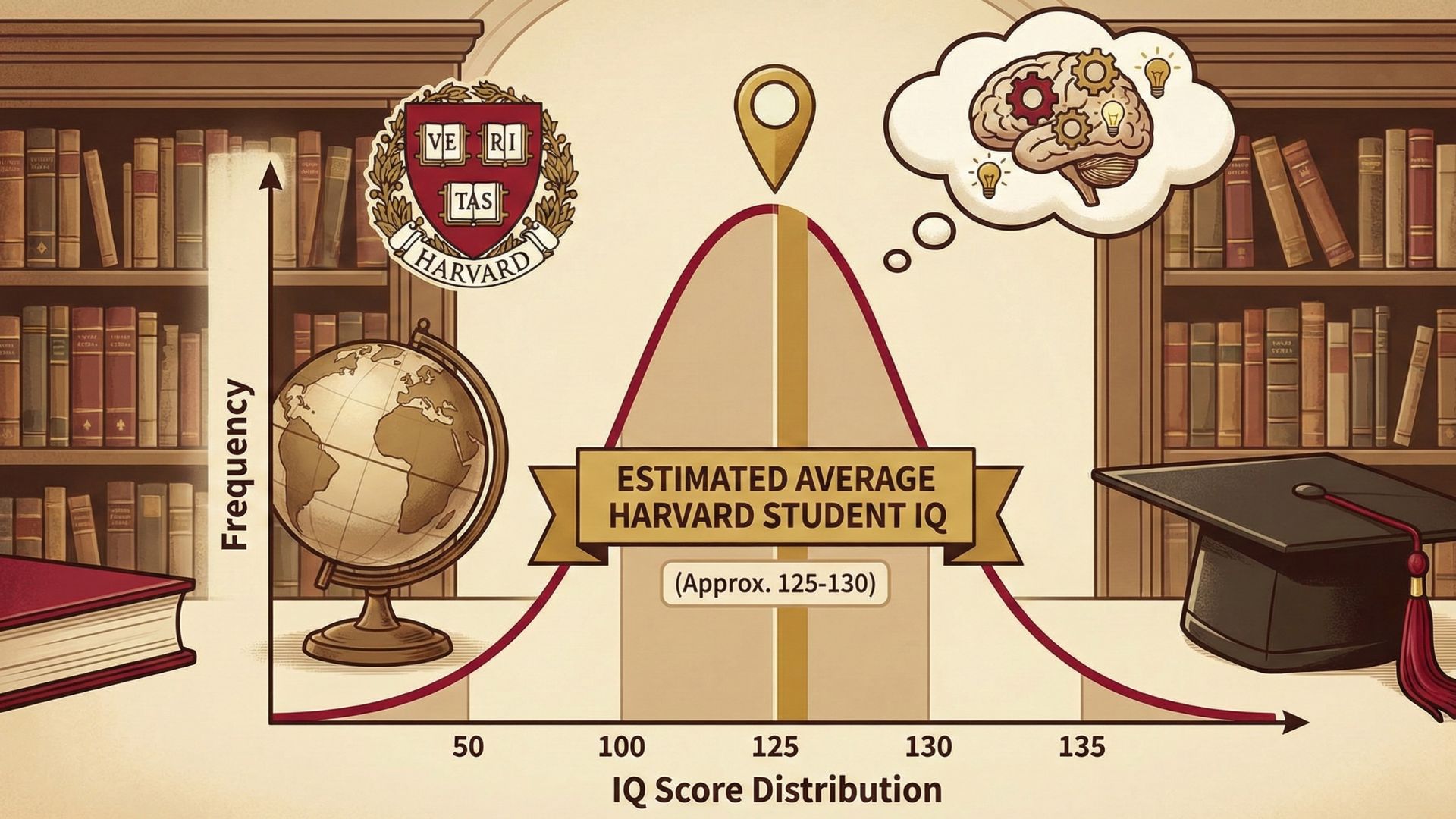
Average IQ of a Harvard Student: The concept of intelligence has fascinated educators, parents, and students for decades, but the curiosity surrounding elite institutions raises the discussion to a different level. Among all universities in the world, Harvard often stands at the center of conversations about academic excellence and intellectual ability. One question that repeatedly emerges in college forums, academic discussions, and general public curiosity is: What is the average IQ of a Harvard student?
While the question sounds straightforward, the answer is far more complex. IQ (Intelligence Quotient) itself is a widely misunderstood metric, often mistakenly used as the primary measure of a person’s intellectual capacity. Harvard University, like most top-tier institutions, does not use IQ tests as part of its admissions process. Instead, it assesses candidates through a broad, holistic approach measuring academic performance, extracurricular excellence, leadership, community engagement, personal qualities, and more.
In this in-depth article, we explore the idea of the “average IQ” of a Harvard student, why the concept exists, how IQ correlates to academic achievement, why it is an incomplete measure of intelligence, and what truly characterizes the average Harvard student academically and cognitively.
We will also examine misconceptions, psychological research, admissions data interpretations, and practical insights into what intellectual traits are more important for success at Harvard than IQ alone.
Important Links and Information
| Topic | Description | Link |
|---|---|---|
| Harvard University Admissions | Official undergraduate admissions site | https://college.harvard.edu/ |
| Harvard Graduate School Admissions | Graduate and professional program admissions | https://www.harvard.edu/admissions-aid/ |
| Harvard Student Life | Information about academic and residential life | https://college.harvard.edu/student-life |
| Harvard Academic Programs | Overview of fields of study | https://college.harvard.edu/academics |
| Harvard Library Resources | Harvard University’s library system | https://library.harvard.edu/ |
| Harvard Fact Book | Institutional research and statistics | https://oir.harvard.edu/fact-book |
Understanding the Concept of IQ
IQ, or Intelligence Quotient, is a score derived from standardized tests designed to measure human intelligence relative to a population average of 100. Tests typically examine:
- Logical reasoning
- Verbal comprehension
- Mathematical ability
- Spatial reasoning
- Pattern recognition
- Memory
However, IQ tests do not evaluate creativity, emotional intelligence, leadership ability, motivation, work ethic, resilience, or discipline—many of which are essential for success at schools like Harvard.
Does Harvard Measure IQ?
The short answer is no. Harvard does not require or collect IQ scores from applicants. There is no section on the Common Application or Harvard supplement asking for anything related to IQ, cognitive test scores (outside of SAT/ACT), or psychometric measures.
Instead, Harvard focuses on:
- Advanced coursework
- Academic achievement
- Extracurricular involvement
- Leadership roles
- Personal essays
- Teacher recommendations
- Community impact
- Intellectual curiosity
Because of Harvard’s holistic review, IQ is not only irrelevant but also impractical as a metric. Admissions committees value a broader definition of intelligence—one that encompasses curiosity, initiative, character, and creativity.
Estimating the Average IQ of a Harvard Student
Since Harvard does not measure IQ directly, any discussion of the “average IQ” of its students is purely interpretative.
However, researchers have attempted to approximate this figure by examining standardized test scores, particularly SAT and ACT results, which correlate moderately with certain components of IQ tests.
Correlational Estimates (Not Official Figures)
Academic analysis of standardized test percentile scores suggests that Harvard undergraduates typically fall into the top fraction of high-performing students nationally:
- SAT and ACT scores for incoming Harvard classes tend to cluster above the 95th percentile.
- Cognitive ability research often correlates top-percentile standardized test performance with IQs in the 130–145 range.
Therefore, estimates often place the average cognitive ability range of Harvard undergraduates between 125 and 140 IQ.
But it is crucial to note:
- This is not an official value.
- IQ is not used in admissions.
- IQ does not fully reflect the multidimensional traits Harvard seeks.
Any fixed number, such as claiming “the average Harvard student has an IQ of X,” oversimplifies an extremely diverse student population.
Why the “Harvard IQ” Question is Misleading
1. Intelligence Is Multi-Dimensional
Harvard students excel in numerous forms of intelligence, such as:
- Analytical reasoning
- Creative thinking
- Emotional intelligence
- Verbal communication
- Collaborative problem solving
- Leadership and influence
- Perseverance and discipline
An IQ test cannot capture all these skills.
2. Harvard Looks for Potential, Not Just Test Scores
A student with perfect standardized test scores might be rejected if they lack curiosity, integrity, or initiative. Conversely, a student with slightly lower test scores might be admitted based on remarkable achievements or personal qualities.
3. Success at Harvard Requires More Than Cognitive Ability
Time management, focus, resilience, and adaptability often matter more than raw reasoning skills.
4. Admissions Consider the Whole Person
Harvard’s holistic review considers:
- The environment in which a student achieved
- Family responsibilities
- Hardships overcome
- Impact on school or community
IQ alone reveals none of this.
What Traits Do Harvard Students Typically Share?
Even though IQ varies widely across the student body, several traits appear consistently among Harvard students.
1. Intellectual Curiosity
A genuine desire to question, explore, and understand complex problems.
2. Strong Work Ethic
Harvard coursework can be demanding, and students must maintain disciplined study habits.
3. Leadership Potential
Harvard seeks students who will become leaders in academics, business, public service, science, and the arts.
4. Creativity and Innovation
Many Harvard students excel not just in academics but in thinking differently or bringing new ideas into the world.
5. Resilience
High achievers often overcome challenges that cultivate strength and determination.
These traits correlate loosely with academic success but not strictly with IQ.
How Harvard Evaluates Academic Potential Without IQ Scores?
Harvard relies on the following indicators:
1. High School Course Rigor
Students who take the most challenging courses available demonstrate academic ambition.
2. Grades and Achievement
Consistent excellence, particularly in advanced or honors courses, signals readiness for college-level rigor.
3. Recommendations
Teachers and counselors help the admissions committee understand a student’s intellectual character.
4. Standardized Test Scores (Optional)
While now test-optional, high SAT or ACT scores can support—but not guarantee—an applicant’s academic readiness.
5. Essays
Essays reveal thought process, analytical ability, originality, and communication skills.
6. Extracurricular Distinction
Academic intelligence can also appear in:
- Research projects
- Competitions
- Clubs and leadership
- Community initiatives
All these provide a far richer picture than IQ alone.
Misconceptions About Harvard Students and IQ
Myth 1: All Harvard Students Are Geniuses
Reality: Harvard admits students with a wide range of strengths, personalities, interests, and cognitive backgrounds.
Myth 2: Harvard Students Have the Highest IQs in the Ivy League
No institution publishes IQ data. Variation exists at all elite schools.
Myth 3: IQ Predicts Success at Harvard
Success is more heavily influenced by:
- Motivation
- Commitment
- Time management
- Emotional stability
- Social skills
Myth 4: Harvard Only Accepts Perfect Test Scores
Many admitted students do not have perfect standardized test scores, highlighting the holistic nature of admissions.
FAQ about Average IQ of a Harvard Student
Does Harvard ask for IQ scores during admissions?
No, Harvard does not require IQ scores and does not measure IQ at any stage.
What is the estimated average IQ of a Harvard student?
Unofficial estimates based on standardized test correlations suggest a range between 125 and 140, but this is not an official Harvard statistic.
Can someone with an average IQ get into Harvard?
Yes. Admissions consider personality, leadership, achievements, and unique contributions—not just cognitive metrics.
Do high SAT or ACT scores mean a student has a high IQ?
Not necessarily. While the tests correlate with some IQ components, they measure different skills and are influenced by preparation.
Does Harvard prefer gifted or prodigy students?
Harvard admits students who demonstrate exceptional potential, whether intellectual, creative, or leadership-based.
Is Harvard the university with the highest average IQ?
There is no official ranking. Such claims are based on speculation and should be interpreted cautiously.
Why do people associate Harvard with high IQ?
Because Harvard is highly selective and attracts high-achieving students, but this does not mean all students fit a narrow cognitive profile.
Conclusion
The idea of determining the “average IQ of a Harvard student” reflects a fascination with intelligence and academic excellence, but it oversimplifies how universities like Harvard operate. Harvard does not measure or use IQ in admissions, and cognitive ability alone does not define the student body. Instead, Harvard values intellectual curiosity, leadership, creativity, resilience, and the potential to contribute meaningfully to society.
While studies might estimate a higher-than-average cognitive ability among Harvard students, the institution’s diversity in backgrounds, talents, and aspirations means no single number can capture what makes a Harvard student exceptional.
Ultimately, Harvard is less about admitting students with the highest IQs and more about admitting those who will make a significant impact on the world.