
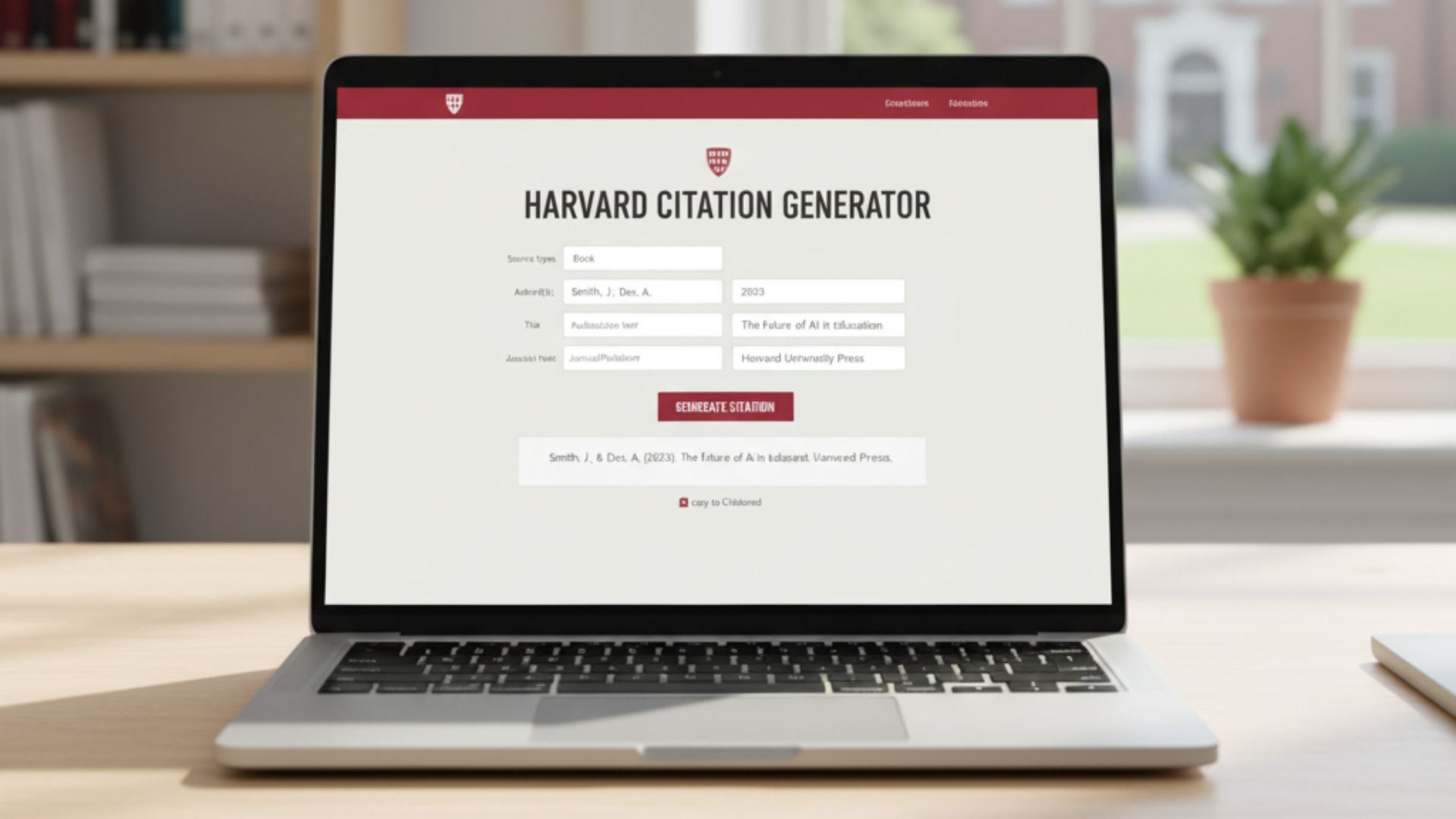
Harvard Citation Generator: Writing an academic paper, research report, or dissertation involves more than just presenting information — it requires proper acknowledgment of the sources you’ve used. This process, known as referencing, ensures academic honesty and helps readers verify your data. One of the most widely used referencing styles across universities is the Harvard referencing style.
However, creating accurate citations manually can be time-consuming and prone to human error. That’s where a Harvard Citation Generator becomes incredibly valuable. This tool automates the citation process, ensuring that all references are formatted according to the Harvard style.
In this comprehensive guide, we will explore everything you need to know about the Harvard Citation Generator — including what it is, how it works, its structure, rules, examples, and a comparison of the best citation tools available today.
What Is the Harvard Referencing Style?
The Harvard referencing style is one of the most popular citation formats used in academic writing. It is a type of author-date referencing system, meaning that the author’s name and publication year are included within the text, with full details provided in a reference list at the end of the document.
It originated at Harvard University, which is why it bears the institution’s name, but the style is now widely adopted by universities across the globe.
A Harvard-style reference includes two main elements:
- In-text citation – a brief note within the text (e.g., “(Smith, 2020)”) that refers to a source.
- Reference list entry – a detailed description at the end of the document providing full publication information.
Example:
- In-text citation: (Brown, 2018)
- Reference list entry: Brown, T. (2018). Social Media and Communication Trends. Oxford University Press.
This straightforward format makes the Harvard style simple, consistent, and ideal for academic writing.
What Is a Harvard Citation Generator?
A Harvard Citation Generator is an online tool designed to automatically create accurate citations and references in the Harvard format. By simply entering details such as the author’s name, publication year, title, and source type (book, website, journal article, etc.), the generator produces properly formatted references ready to include in your assignment or research paper.
It eliminates the need to remember complex punctuation and formatting rules, helping students and researchers save time and reduce errors.
Key features of a citation generator include:
- Automated citation creation
- Support for multiple source types (books, journals, websites, videos, etc.)
- Copy-and-paste functionality
- Ability to download or export reference lists
- Integration with writing software and research tools
Why Use a Harvard Citation Generator?
Using a Harvard Citation Generator provides several benefits for writers, researchers, and students:
a. Accuracy
Citing sources manually often leads to formatting errors. A citation generator ensures each reference follows official Harvard rules.
b. Time Efficiency
Creating citations manually can take hours, especially for long research papers. A generator does it in seconds.
c. Consistency
Academic work requires consistent formatting throughout. The tool ensures uniformity in punctuation, italics, and layout.
d. Error Reduction
Missed commas or misplaced parentheses can cost marks. A generator minimizes such errors.
e. Supports Multiple Sources
Modern citation generators can handle books, journal articles, websites, online videos, newspapers, and more.
f. Educational Value
Using these tools helps students understand how citations are structured and why they are essential.
How Does a Harvard Citation Generator Work?
Most Harvard Citation Generators are user-friendly and intuitive. Here’s how they typically work step-by-step:
- Select the Source Type
Choose what kind of source you are citing — a book, website, journal, video, or report. - Enter Source Details
Fill in required fields such as author name(s), title, publication date, publisher, URL, and access date. - Generate the Citation
The tool automatically formats the information according to Harvard style conventions. - Copy or Export the Citation
You can copy the citation directly into your document or download the full list in formats such as.docxor.bib.
Some advanced tools even allow batch citation creation, where multiple references are generated at once using identifiers like ISBN or DOI.
Harvard Referencing Structure and Rules
To use the Harvard style correctly, it’s essential to understand its formatting rules. These apply to both in-text citations and the reference list.
a. In-Text Citations
- Format: (Author’s Last Name, Year of Publication)
- Example: (Johnson, 2019)
If quoting directly, include the page number: (Johnson, 2019, p. 45).
If there are two authors: (Smith and Clark, 2020).
For three or more authors: (Brown et al., 2021).
b. Reference List Format
The reference list is alphabetically arranged by the author’s surname.
Common formats:
- Book:
Author(s) Last name, Initial(s). (Year). Title of Book. Edition (if not first). Place of Publication: Publisher.
Example:
Turner, J. (2020). Global Economics Today. 2nd ed. London: Routledge. - Journal Article:
Author(s). (Year). “Title of Article.” Title of Journal, Volume(Issue), Page numbers.
Example:
Lee, R. (2021). “Climate Change and Urban Resilience.” Environmental Studies Journal, 12(3), pp. 150–165. - Website:
Author(s). (Year). Title of Web Page. [online] Available at: URL [Accessed Day Month Year].
Example:
Brown, M. (2019). Digital Learning in Higher Education. [online] Available at: https://www.example.com [Accessed 5 July 2022].
Common Source Types in Harvard Style
| Source Type | Format Example |
|---|---|
| Book | Smith, J. (2018). Introduction to Psychology. London: Penguin. |
| Journal Article | Adams, K. (2020). “AI and Society.” Tech Journal, 15(2), pp. 100–112. |
| Website | Johnson, D. (2021). Digital Ethics. [online] Available at: https://example.com [Accessed 12 Oct 2023]. |
| Report | World Health Organization. (2020). Global Health Report. Geneva: WHO. |
| Video | Harvard University. (2022). Commencement Highlights. Available at: https://www.harvard.edu [Accessed 5 May 2023]. |
| Newspaper Article | Lee, C. (2020). “New Research Trends.” The Times, 25 March, p. A3. |
Advantages and Limitations of Harvard Citation Generators
Advantages:
- Speed and convenience.
- Reduces formatting errors.
- Provides instant output in proper format.
- Can handle a variety of citation types.
Limitations:
- Some tools may produce inconsistent results depending on the database.
- Users must still verify the citation accuracy manually.
- Incorrectly entered data will result in incorrect references.
Therefore, while generators are powerful tools, users must double-check outputs to ensure correctness and adherence to institutional guidelines.
Best Harvard Citation Generators
Here are some widely used tools that support Harvard citation style:
| Tool Name | Website / Link | Key Features |
|---|---|---|
| Cite This For Me | https://www.citethisforme.com | Easy-to-use interface, supports multiple formats, quick export options. |
| MyBib | https://www.mybib.com | Free, ad-free, accurate Harvard referencing. |
| Scribbr Harvard Generator | https://www.scribbr.com/harvard-citation-generator | Offers examples, templates, and detailed guidance. |
| BibGuru | https://www.bibguru.com | Fast citation builder with Chrome integration. |
| CiteFast | https://www.citefast.com | Simple design, works offline, supports multiple citation styles. |
| ZoteroBib | https://zbib.org | From the creators of Zotero, generates Harvard-style citations instantly. |
These tools are trusted by students, educators, and researchers for accuracy and user-friendliness.
Common Mistakes to Avoid in Harvard Referencing
Even with citation generators, users must remain cautious about common pitfalls:
- Incorrect author order – Always list authors in the same order as in the source.
- Missing publication year – If unavailable, use “n.d.” (no date).
- Incomplete URLs or access dates – For online sources, always include the full link and the date accessed.
- Inconsistent capitalization – Only capitalize the first word of titles (unless proper nouns).
- Not alphabetizing the reference list – Always arrange sources alphabetically by the author’s surname.
Being mindful of these issues ensures a polished and professional academic paper.
The Importance of Citing Sources Properly
Proper citation is not just a technical requirement — it is an ethical obligation in academic and professional writing.
Citing sources properly:
- Gives credit to original authors.
- Avoids plagiarism and academic misconduct.
- Strengthens the credibility of your arguments.
- Allows readers to trace your research path.
- Demonstrates research rigor and transparency.
A well-cited paper reflects integrity and academic maturity — qualities valued in every scholarly discipline.
Important Links and Information on Harvard Citation Generators
| Category | Details / Links |
|---|---|
| Official Style Guide | https://www.mendeley.com/guides/harvard-citation-guide |
| Popular Citation Tools | MyBib, Scribbr, Cite This For Me, ZoteroBib |
| Primary Citation Format | Author-Date System |
| Best Use | Academic essays, dissertations, journal articles |
| Common Mistakes | Wrong author order, missing URLs, incorrect punctuation |
| Alternative Styles | APA, MLA, Chicago, IEEE |
| Main Advantage | Quick, consistent, and accurate referencing |
| Availability | Web-based, Free |
| Recommended Practice | Always double-check generated citations |
| Example Citation | Smith, J. (2019). Business Ethics in Practice. London: Routledge. |
FAQ about Harvard Citation Generator
What is the Harvard citation style?
The Harvard citation style is an author-date referencing system used in academic writing, where sources are cited in-text and fully referenced at the end of a document.
Why use a Harvard Citation Generator?
It automates the referencing process, saving time, improving accuracy, and ensuring consistency in formatting.
Are Harvard citation generators free?
Yes, most citation generators like MyBib, Cite This For Me, and Scribbr offer free Harvard referencing options.
Do I still need to check citations generated automatically?
Yes. Always review the output for accuracy and compliance with your institution’s specific referencing guidelines.
Can I use a Harvard generator for other styles like APA or MLA?
Most modern citation generators allow switching between multiple styles, including APA, MLA, and Chicago.
Do citation generators store my data?
Most reputable tools do not store your personal data unless you create an account. Always check the privacy policy before using.
Can I use Harvard referencing for websites and online content?
Yes. The Harvard style supports citations for websites, videos, and other online materials, including access dates and URLs.
Conclusion
The Harvard Citation Generator is an indispensable tool for students, educators, and researchers striving to produce well-referenced and credible academic work. By automating the process of citation creation, it eliminates the stress of formatting errors, saves time, and ensures that all sources are properly acknowledged.
However, while these tools provide efficiency and accuracy, users must understand the fundamental principles of the Harvard style and verify each entry to maintain academic integrity.
In an era of information abundance, proper citation is a mark of intellectual honesty. Using a Harvard Citation Generator ensures that your research not only stands out for its quality but also adheres to the highest standards of scholarly ethics and professionalism.